
- Shop floor — real machines running, not a showroom.
- Equipment age — maintenance records, not just brand names.
- Capacity — machine hours and people to ramp your order.
- Financial stability — age, assets, retention, customer spread.
- Compliance — labor and environmental standards that are documented.
What should you see on the shop floor during a factory audit?
The floor tells you in ten minutes what a website cannot tell you in ten pages: whether machines are running, whether work-in-progress is organized, and whether the place is managed or improvised. Look for machines actually cutting parts, staged work-in-progress with labels, a clean inspection area, and people who can explain what they are doing. A quiet, empty floor during working hours, or a floor that looks staged, is a warning.
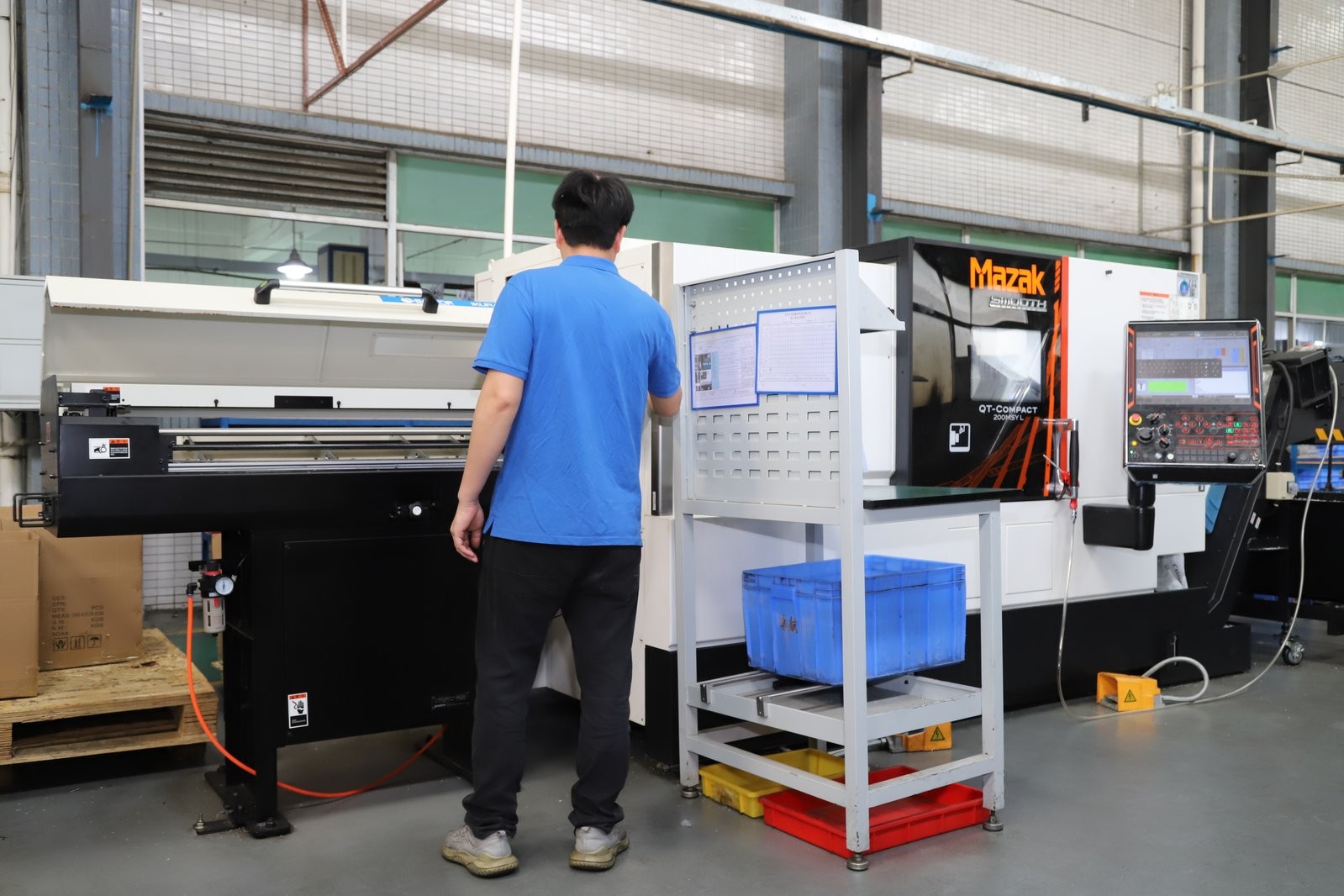
This facility is a 6,800 m² site in Hengli Town, Dongguan, Guangdong, run by Dongguan Zhuohang Ltd — the legal name behind the CNC Machining Precision brand — operating since 2005. The floor is organized around the process flow: incoming material inspection, machining, in-process QC, finishing, and final inspection before packing.
How do you verify equipment age, condition, and maintenance?
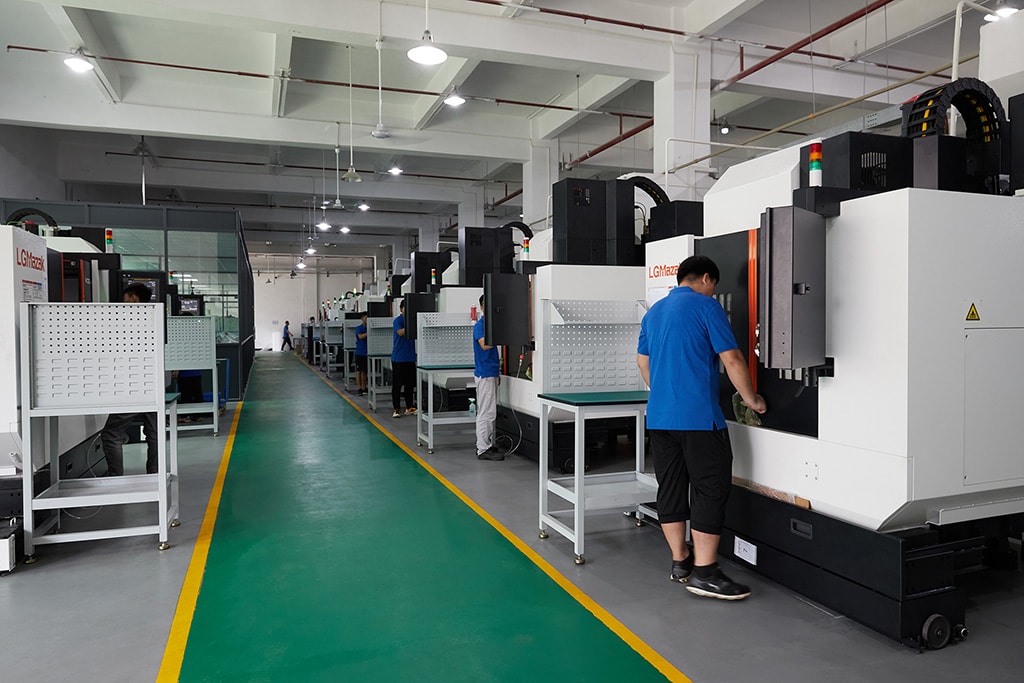

Brand names on a machine list do not tell you whether the machines hold tolerance today. The audit looks at condition and maintenance: ask to see maintenance records, check whether the machines are calibrated and cleaned, and note the mix of machine types — a shop running 20+ 5-axis centers is a different animal from one running a single aging 3-axis mill.
| Equipment category | Count | Audit note |
|---|---|---|
| 3-axis milling | 50+ centers | Workhorse capacity for prismatic parts |
| 4-axis milling | 20+ centers | Indexed features in fewer setups |
| 5-axis milling | 20+ centers | Complex geometry, single setup |
| CNC turning | 25+ lathes | Round parts to Ø720 × 1280 mm |
| Precision grinding | 7+ machines | Surface, centerless, cylindrical to ±0.002 mm |
| Inspection | 20+ instruments | Hexagon CMMs, XRF, vision, hardness |
The named list is the point: a real factory can name its machines and show them running; a reseller recycles a brochure. On a visit, pick two or three machines from the list and confirm they exist and are maintained.
How do you audit capacity and ramp-up capability?
A supplier that can make ten parts may not be able to make ten thousand, and the audit question is about ramp: does the factory have the machine hours and the trained people to scale your order without quietly subcontracting it to someone you never audited? Capacity signals are concrete — total machines, floor area, headcount, and the depth of a single process.
The numbers here support a ramp: 100+ production machines, a 6,800 m² facility, 100+ employees of whom 80%+ are skilled technicians, and an annual output of 1,000,000+ parts. Staff stability reinforces it — 60% of employees have 5–10 years of tenure, which means the people running your job know the process, not just the button.
How do you assess financial stability without the books?
You will rarely see a private supplier's balance sheet, but stability shows up in indirect signals you can read on a visit. The proxies are age, assets, retention, and customer spread. This factory was founded in 2005 — long enough to have survived multiple demand cycles — under a founder with 28 years in the industry. It owns its 6,800 m² site and machine park rather than leasing capacity, its people stay (60% with 5–10 years), and it serves 100+ domestic and overseas customers across automotive, robotics, electronics, medical, and automation. A supplier concentrated on one customer or staffed by churn is a risk that surfaces mid-order; a stable one is a partner you can ramp with.
How do you check labor and environmental compliance?
For buyers with their own ESG and supplier-responsibility requirements, compliance is part of the audit, not an afterthought. The labor record here is documented: no forced or child labor, written labor contracts at hire, social insurance for all employees, legal working hours with at least one rest day per week, and equal opportunity. The code of conduct covers anti-bribery, confidentiality and IP protection, health and safety, and whistleblower protection.
On the environmental side, the site holds ISO 14001:2015 and runs rooftop solar panels generating roughly 20,000 kWh of green power per month, with documented noise, waste-water, and air-control procedures. Customer IP is protected physically — sensitive paper files in a secured space, electronic data on encrypted drives. These are the signals a responsible buyer checks, and they are available on request.
What should a factory tour reveal about process flow?
A well-run factory flows in one direction — raw material in, finished parts out — and the flow should match the documented process. The flow here runs: incoming material inspection, CNC turning, CNC milling, in-process QC, post-processing, finishing or heat treatment, cleaning, final inspection, packing, and shipping. Each gate leaves a record, and the MES/ERP system ties the record to the lot. When you tour, ask the guide to walk you along that flow and show you a gate record; a factory that can do it live is one where the process is real, not just drawn.
How do you structure the audit day itself?
A factory audit is a short, structured exercise, and it is most useful when you know what you are checking before you arrive. The order that works: open with the certificates and the equipment list, walk the floor along the process flow, stop at the inspection area and ask for a CMM report and an SPC chart, trace one part back to its raw material, and close with the commercial questions — MOQ, lead time tiers, and payment terms. Take the eight-point checklist from the homepage and run it against the floor in a single morning.
- A floor that is quiet or staged during working hours.
- Machines that cannot be named, or maintenance records that do not exist.
- An inspection area with no CMM report or SPC chart to show.
- No answer when you ask to trace one part back to its material.
This factory is open to buyer audits. Contact Felipe at [email protected] to schedule a visit — pickup can be arranged, and the sales team works in English, Portuguese, Spanish, French, and Chinese, and Japanese.
How do you audit the people, not just the machines?
Machines do not hold tolerance by themselves; the people setting up, running, and inspecting them do. A factory audit should spend as much attention on the workforce as on the equipment, because staff stability is a leading indicator of quality consistency. The signals to read are the share of skilled technicians, how long people stay, and whether the operators can explain their work.
Here the numbers point the right way: 100+ employees of whom 80%+ are skilled technicians, with 60% holding 5–10 years of tenure and 70% in the 20–35 age range, under a founder with 28 years in the industry. On the floor, ask an operator to walk you through a setup and an inspector to show a measurement — a workforce that can explain the process is one that can repeat it. That is the difference between buying from a factory and buying from a building full of machines.
What machine brands and turning platforms run on the floor?
The brand mix is a maintenance and capability signal, not a vanity list. A shop that runs one brand has a single parts supply and a single service channel; a shop that runs several has chosen each platform for a job it actually does. The floor here runs Mazak machining centers for multi-axis work, Brother high-speed drill-and-tap centers for high-volume small parts, TSUGAMI and Sodick platforms, and Citizen and Star turning centers for slender, precision-turned shafts.
Each brand on that list earns its place by geometry. A Swiss-type turning center — the TSUGAMI, Citizen, and Star class — holds a long, thin shaft close to the guide bushing so it cuts without flexing, which is exactly what a standard CNC lathe cannot do on a slender part. A high-speed drill-and-tap center drills and taps many small features faster than a general mill. A multi-axis Mazak holds a prismatic part in one setup and machines five faces. When you audit, the useful question is not "what brands do you run" but "which platform cuts my most difficult feature", and whether the answer names a machine that is actually on the floor.
The maintenance side is the same question with a different lens. A named brand means a named dealer, a parts channel, and a service history; an anonymous "CNC machine" means none of the three. A shop that can show you the maintenance and calibration record per machine is running equipment as a controlled asset. A shop that shows you a brand logo and nothing else is asking you to trust the badge instead of the record.
How do Incoterms and shipping fit into the factory audit?
Where the part is made is half the story; where the risk transfers is the other half. Incoterms are the standard shorthand for who pays the freight, who insures the goods, and at what point you own the risk, and they belong in the audit because they change what "delivery" actually means. The common terms, read simply, are:
- EXW (Ex Works): the goods are made available at the factory gate, and you own every cost and risk from that point on.
- FOB (Free on Board): the seller delivers the goods to the port and clears export; risk transfers to the buyer once the goods are on board the vessel.
- CIF (Cost, Insurance, Freight): the seller pays freight and insurance to the destination port, but the risk still transfers to the buyer at loading.
- DAP (Delivered at Place): the seller delivers to a named place, and you handle import clearance and the final leg.
The audit question is simpler than the acronyms: does the supplier state the term in writing, and does it match the documentation that ships? An EXW quote looks cheaper because it contains no freight; a DAP quote looks pricier because it does. A supplier that names the term and the documents — commercial invoice, packing list, and the certificate of origin your customs broker needs — is giving you a legible chain of custody for the goods, the same way it should give you a legible chain of custody for the lot. A supplier that ships "however is cheapest" is deciding your risk for you without asking.
What this shop actually runs
Capability evidence should come as specifics, not slogans. Behind this guide is a 6,800 m2 plant in Dongguan, China running 100+ CNC machines with 100+ staff. The machine list by category:
- 5-axis machining centres (10+) - Mazak VARIAXIS I-600 (510/910/510 mm travel, 12,000 rpm, 22 kW, 71.6 N·m, 30-tool BT40) and Mazak INTEGREX I-250H S (B-axis 0.0001°, 24 kW, 124 N·m, 38-tool HSK-A63). Intended for compound-angle parts, single-setup multi-face prismatic work, and aerospace fittings where datum transfer loss is unacceptable.
- 3-axis / 4-axis machining centres (50+) - Brother SPEEDIO S500Z2N / S700Z2N (10,000 rpm, 14/21-tool ATC, 0.7 s tool-to-tool, Z-axis 2.2 G) and Mazak VCE-430A L / VCE-570C L (10,000 rpm, 118 N·m, 24-tool ATC). Intended for prismatic parts, plates, brackets, housings.
- Swiss-type turning centres (10+) - Citizen Cincom A20-3F7 (Φ20 mm, 10,000 rpm), TSUGAMI B0206-III / B0205-III (Φ20 mm, 0.1 µm), STAR SR-32JII / SR-32J Type N (Φ32 mm, 8,000 rpm). Intended for long, slender rotational parts at ±0.002 mm.
- CNC turning centres (20+) - HEADMAN T70M/1250 (720 mm swing, 117 mm bore, 3,000 rpm, BMT75 12-station turret). Intended for shafts, bushings, flanges up to ±0.002 mm.
- Wire EDM (5+) - Sodick AQ535L (550/350/300 mm travel, ±20° taper, 800 kg workpiece). Intended for hardened tool steel, internal splines, sharp internal corners that milling cannot reach.
- Inspection: Hexagon CMM + 20+ gauges - Hexagon CMM for coordinate measurement, plus vision system, profilometer, hardness tester, coating thickness gauge, XRF for material verification. The 10:1 rule (gauge 10x more accurate than the band) is applied to every feature.
- Machine highlights - VARIAXIS I-600: one-setup multi-face 5-axis + MAZA-CHECK auto-calibration; INTEGREX I-250H S: DONE-IN-ONE mill-turn, B-axis 0.0001° + Ai thermal shield; SPEEDIO S500Z2N / S700Z2N: Z-axis 2.2 G + 0.7 s ATC; Swiss-type: guide-bush switchable + 0.1 µm resolution.
Tolerance: ±0.003 mm CNC milling / ±0.002 mm CNC turning / ±0.002 mm grinding and wire EDM. Capability: Ppk >= 1.67 initial on key characteristics, Cpk >= 1.33 ongoing.
Certificates: ISO 9001:2015 (116024/A/0001/UK/En), IATF 16949:2016 (131941/A/0001/SM/En, with design clause 8.3 excluded, stated openly) and ISO 14001:2015 (116024/B/0001/UK/En), issued to Dongguan Zhuohang Ltd, registration 91441900MA4UWT6X39, founded 2005.
Where we ship: Austria, Belgium, the Czech Republic, Denmark, France, Germany, Greece, Hungary, Ireland, Italy, the Netherlands, Spain, Sweden and the United Kingdom in Europe; Brazil, Canada, Mexico and the United States in the Americas; China, Israel, Japan, Singapore and Sri Lanka in Asia; Australia and New Zealand in Oceania; and South Africa in Africa — plus other countries and regions worldwide, shipped from our base in Dongguan, China.
Contact: Felipe Iglesias, [email protected], +86 13126536955.
Come audit the factory yourself
Schedule a visit with [email protected] or +86 13126536955 and walk the floor with the checklist in hand.
Frequently Asked Questions
Where is the factory located?
No. 8, Shuibian Songyuan Road, Hengli Town, Dongguan, Guangdong, China 523470. Dongguan Zhuohang Ltd has operated the site since 2005, and buyers are welcome to schedule an on-site audit.
How large is the facility and how many people work there?
The facility is 6,800 m² with 100+ employees, of whom 80%+ are skilled technicians. The staff is stable, with 60% holding 5–10 years of tenure, which is a direct signal for quality consistency.
What equipment does the factory run?
100+ production machines — 50+ 3-axis, 20+ 4-axis, and 20+ 5-axis mills, 25+ lathes, and 7+ grinders — plus 20+ inspection instruments. The named list is verifiable on a factory visit.
What is the annual output capacity?
The factory produces 1,000,000+ parts per year across automotive, robotics, electronics, medical, and automation, serving 100+ domestic and overseas customers.
Is the factory environmentally responsible?
Yes. The site holds ISO 14001:2015 and runs rooftop solar panels generating roughly 20,000 kWh of green power per month, with documented noise, waste-water, and air-control procedures.
What labor standards does the factory follow?
No forced or child labor, written labor contracts at hire, social insurance for all employees, legal working hours with at least one rest day per week, and equal opportunity — consistent with a documented code of conduct.
How do I arrange a factory visit and audit?
Contact [email protected] or call +86 13126536955 to schedule a visit. The sales team works in English, Portuguese, Spanish, French, and Chinese, and Japanese, and pickup can be arranged.
How do I assess the supplier's financial stability?
Use indirect signals: founded in 2005, a founder with 28 years in the industry, its own 6,800 m² facility and machine park, stable staff, and a diversified base of 100+ customers.
Standards referenced on this page
- ISO 14001 — Environmental management systems — Requirements with guidance for use
- ASTM A582/A582M-12 — Standard Specification for Free-Machining Stainless Steel Bars
- IATF 16949:2016 — Automotive quality management system standard